
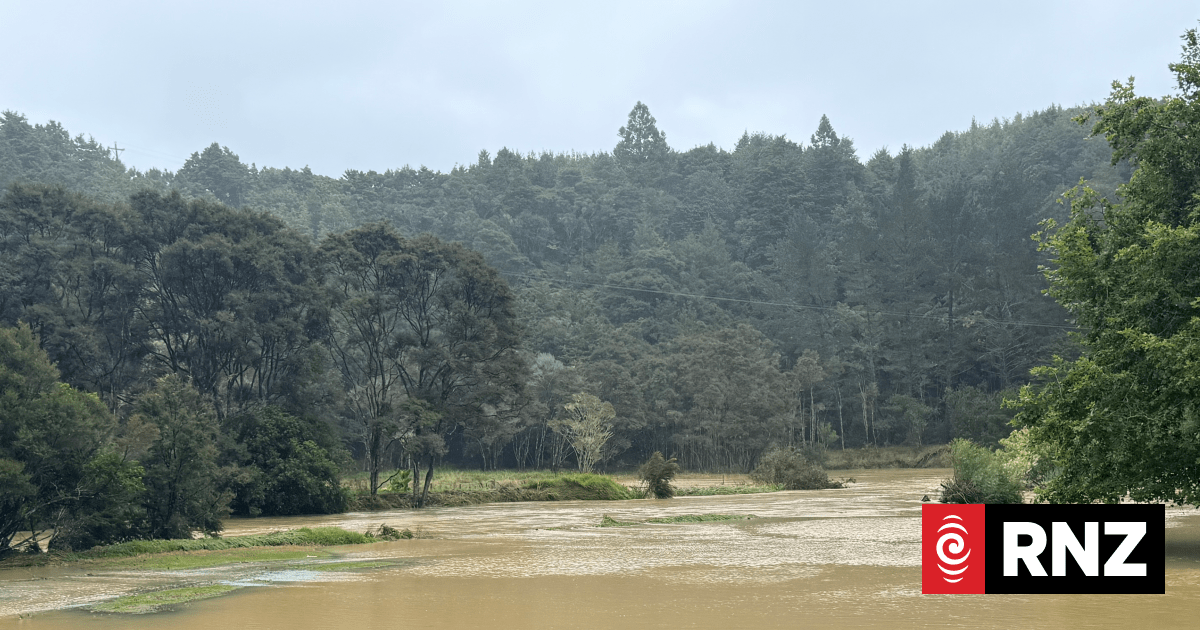

Flooding around Ngunguru Road, east of Whangārei in January this year.
Photo: RNZ / Susan Edmunds
Whangārei District Council is advising anyone who doesn’t feel safe ahead of more heavy rain in the region to leave their homes now, before the red weather warning kicks in.
MetService has upgraded its rain warning to red for areas east of Kaikohe, from Doubtless Bay down to Whangārei.
In those areas up to 320mm of rain was possible over a 36-hour period starting at 4pm on Wednesday.
Posting on its Facebook page, the council said it was monitoring the situation alongside Civil Defence.
“People whose homes were impacted by flooding and land slips in the January weather event, who don’t feel safe, are advised to leave today to a safe location either with family and friends or to a local marae.
We are advising people to leave today, ideally during daylight hours,” the post said.
An orange heavy rain warning remained in place for the rest of Northland, as did an orange strong wind warning.
Northland Civil Defence said the red heavy rain warning – the highest level possible – is a sign people need to prepare for what’s to come during the next few days.
“Keeping in mind those red warnings are really only issued for the most severe weather events, that really does signal this is one to be taken seriously,” spokesperson Zach Woods said.
Woods said Northlanders might not experience warning levels of rain straight away.
“This is expected to be a long duration event with heavy rain and strong winds continuing over several days. MetService expects the rainfall to intensify over time and reach some quite significant levels as the system develops,” he said.
“The main period of concern at this stage is that Thursday afternoon through to Friday morning, when we could see some very heavy downpours on top of all the rain that’s already fallen, particularly around the east coast of the Far North.”
Woods said that created potential for “really dangerous river conditions” as well as possible floods, slips, landslides, and hazardous driving conditions.
“Of course we could see road closures, and some power outages due to the strong winds as well.”
Woods said it remained “an evolving situation” so he urged Northlanders to stay up to date with the latest forecasts as well as advice from MetService and their local councils.

A big swell pounds the Paihia shoreline during a previous storm.
Photo: Peter de Graaf
Locals brace for a wild few days
Anthony “Vinnie” Pivac, the owner of Zane Grey’s Restaurant on the Paihia waterfront, said the predicted 50 knot easterly gusts could be damaging – but it was the sea he was keeping a close eye on.
When Cyclone Gabrielle caused $100,000 worth of damage and lost contracts in 2023, that came down to a combination of strong winds and a 7-metre swell.
So far the swell was forecast to reach just 2.5m, he said.
“If it had swell behind this easterly then I would be panicking, but it’s not going to be too bad. On the flip side of things, we’re just going to have today and tomorrow of horrendous rain and no customers,” he said.
“But for now we’re sitting cosy. I’m going to sit here, have a few beers and see what happens on either side of the tide.”
However, Pivac said he would keep monitoring the forecast and was not taking anything for granted.
“Mate, we’re in New Zealand, so the weather changes every five minutes.”

File pic
Photo: RNZ / Sam Olley
Any time the swell reached 4m he removed parts of the decking around the restaurant to reduce the impact of the waves, but that was not necessary at this point.
Pivac said the most damaging winds for Paihia were northeasterlies. Easterly winds were bad if they coincided with big swells.
“Anything from the north, it’s hold onto your britches,” he said.
The next high tides were due in the Bay of Islands around 1.20pm on Wednesday and 2am and 2.20pm on Thursday.

Heavy seas pound Paihia wharf during Cyclone Gabrielle in 2023.
Photo: RNZ / Peter de Graaf
Power cuts a concern
Meanwhile, Richard Holt, the owner of Cellini’s Ice Cream and Espresso Bar on nearby Williams Road, said power cuts caused by wild weather were the biggest threat to his business.
He had invested in a bunker freezer to keep ice cream cold in the event of a serious power outage – but if it lasted more than eight or nine hours, he would still lose his stock.
Holt said he did not expect to sell many ice creams in Paihia today but there had been plenty of demand for coffee this morning.
Further down the east coast in Ōakura, in the Whangārei District, residents still recovering from the devastating January storm are preparing for more rain.
That deluge swept through multiple homes and baches, triggered landslides, and severely damaged the newly renovated Ōakura Community Hall.
The Whangārei District Council had planned to hold a public meeting on Thursday afternoon to update locals on storm recovery efforts.
That meeting had now been postponed until 6pm on Tuesday at the Ōakura Sports Complex.
The main road from Ōakura south to Whangārei remained closed due to a massive slip at Helena Bay Hill, and eight homes and buildings were still red-stickered, meaning they were too dangerous to enter.
Sign up for Ngā Pitopito Kōrero, a daily newsletter curated by our editors and delivered straight to your inbox every weekday.