
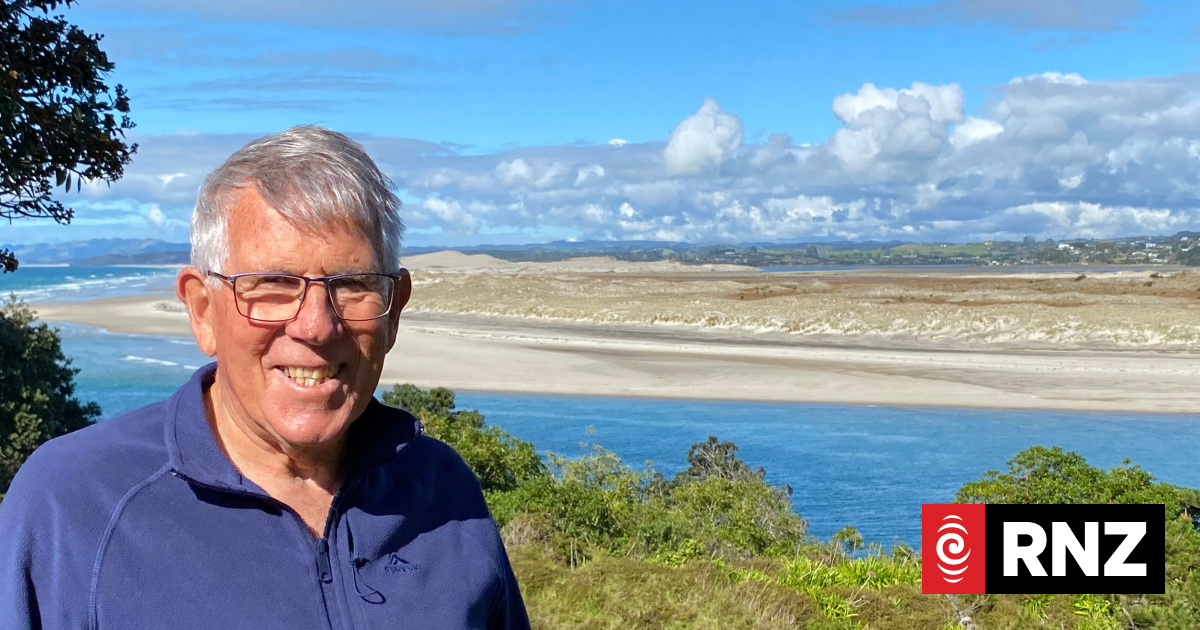

Mangawhai Harbour Restoration Society chair Peter Wethey.
Photo: Local Democracy Reporting / Susan Botting
A Mangawhai community leader is warning of the risk of another major sandspit breach within 15 years.
Mangawhai Harbour Restoration Society (MHRS) chair Peter Wethey said experts had indicated a breach of Mangawhai Harbour’s iconic sandspit was an ‘urgent reality’ without boosted resilience action.
Wethey’s comments came at the recent 35th anniversary celebration of the Mangawhai Rebels.
The group of locals took renegade action to reopen the harbour’s blocked northern mouth following a major breach in the sandspit a kilometre further south, which began in 1978.

Wethey said coastal starvation had hurt the drumstick spit – which is one of fewer than half a dozen of sandspits of its type in New Zealand.
The spit had lost more than 420,000 tonnes of sand in just six years. That starvation was the equivalent of 26,000 truckloads of sand.
“It’s left the spit critically thin with experts warning of a high prospect of another breach within 15 years,” Wethey said.
He said this risk was the backdrop for ongoing community efforts towards spit resilience and closely-linked harbour health.
Wethey said those efforts took place against a backdrop of coastal inundation and sea level rise increasingly threatening the spit.
He told those at the anniversary celebration in Mangawhai that the people in the Big Dig group who took renegade action had done their bit by sorting out the first major breach.
Community leader and Mangawhai Rebels member Richard Bull (MCZM) said grit and long-term dedication had always been required to maintain the harbour’s pulse.
In 1991’s Big Dig, the rebels, operating more than 40 diggers and other heavy machinery, descended on the harbour’s blocked northern entrance. They carved a 30m wide channel to reopen it. This had progressively blocked over the 13 years following the major breach in the sandspit’s narrowest point.
A huge 1978 storm started the large breach through the drumstick sandspit’s narrow ‘waist’. This was cemented with Cyclone Bola a decade later which worsened the breach, confirming it as the harbour’s main exit point to the ocean.
Wethey said harbour dredging, sand fencing and planting work and more done by the community over many years since the rebels’ work aimed to boost the spit’s resilience.
“We must recognise that riparian planting, sediment control and controlled urban development are essential to protecting our water from the hills to the sea.
“By protecting the sandspit, ensuring vital tidal flow and managing mangrove encroachment for a healthy harbour, we preserve a thriving waterway for boaties, fishers and families, while providing a sanctuary for the endangered tara iti (fairy tern) (that use the harbour) and other at-risk wildlife.”
Wethey is the society’s representative on a new Kaipara District Council (KDC) Mangawhai Harbour working group set up in February.
He said the group would add an important governance-level involvement in the harbour’s health.
Kaipara Mayor Jonathan Larsen said the new working group had been set up to advocate for the health of the harbour and its tributaries.
He said it was important to build on the work of the Mangawhai Rebels and MRHS.
“A huge amount of work has been undertaken since then by the society and other groups who continue to care for the harbour.
“Now, with changing conditions and new pressures, we’re seeing more mangroves, more sediment and shallower channels,” Larsen said.
“I am old enough to remember back in the seventies when the sandspit was breached by various storms including Cyclone Bola and the northern end of the sandspit became a stagnant smelly mess.
“It’s time to look to the future and ensure the harbour is healthy and functional for future generations,” Larsen said.
Former Northland Regional Council chair, and Resource Management Act commissioner, Mark Farnsworth will chair the group. KDC councillor Craig Jepson will represent his council.
MHRS’ chair Wethey will also be part of the group as well as Northland Regional Council (NRC) representation, community group Mangawhai Matters, the Department of Conservation and Te Uri o Hau.
LDR is local body journalism co-funded by RNZ and NZ On Air.