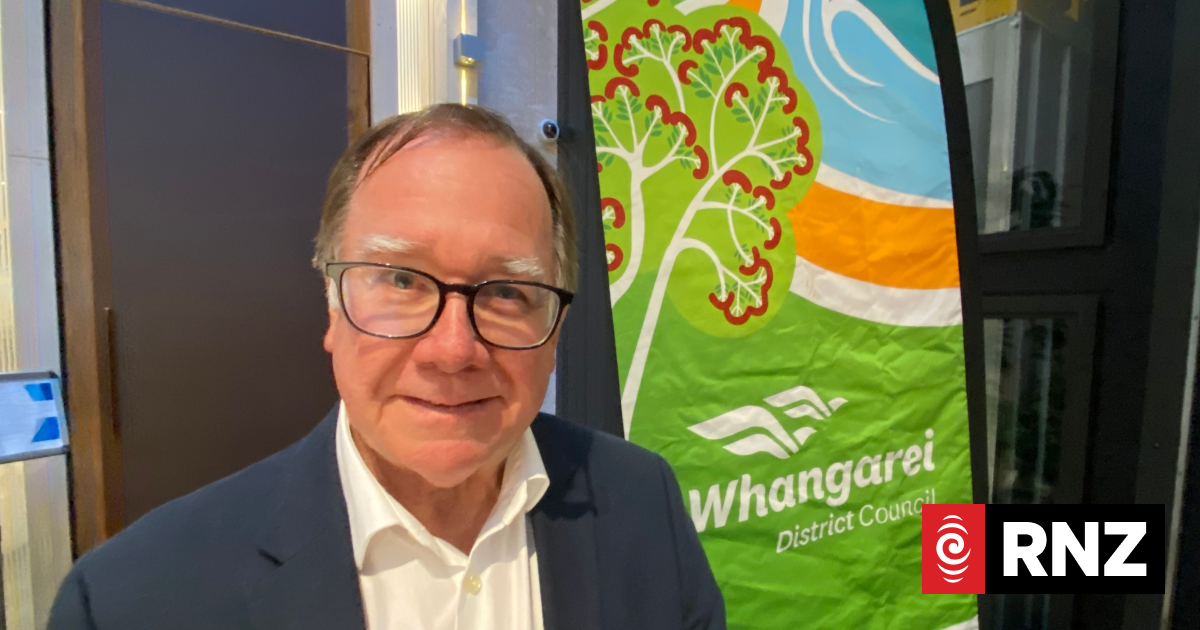

Former minister of foreign affairs Murray McCully chairs Whangārei District Council’s new council-controlled trading organisation, created to manage council-owned property where there are commercial or strategic opportunities.
Photo: LDR / Susan Botting
Sorting Whangārei’s central flood risk and geotechnical problems is critical to unlocking investment and securing the city’s future, the head of the country’s newest council commercial property company says.

Whangārei District Holdings Limited (WDHL) chair Murray McCully said the city centre risked a third-rate future if long-standing flooding and ground stability issues were not properly addressed.
The former minister of foreign affairs chairs Whangārei District Council (WDC)’s new council-controlled trading organisation (CCTO), created to manage council-owned property where there are commercial or strategic opportunities.
McCully said flooding and geotechnical constraints had held the city back for too long and needed to be dealt with if Whangārei was to move forward.
He was speaking to about 100 business leaders at a council-hosted event at Te Iwitahi civic centre on Monday. The event focused on opportunities for Whangārei and how council assets and property could be used to help realise them.
McCully said a proper determination of the actual flood and geotechnical risk facing the city was required, followed by the use of new technology, engineering and innovation to manage and mitigate those risks.

Flooding on a Whangārei road in January.
Photo: RNZ / Calvin Samuel
The joint WDC-Northland Regional Council (NRC) urban flood strategy highlights that much of the inner central area, including the Town Basin, Port Road and parts of the city fringe, sits on low-lying floodplain and reclaimed estuary that historically absorbed floodwaters and tidal flows.
While recent projects have helped reduce flood risk in some locations, the councils acknowledge major city-wide flood protection measures such as storm-surge barriers and pumping systems have not yet been built.
This means significant flood risk remains in reclaimed, low-lying parts of the city centre.
Whangārei also faces ongoing geotechnical challenges because large parts of the city centre have been developed on reclaimed estuarine land.
Council and consultant reports identify soft soils, high groundwater levels, differential settlement and increased liquefaction susceptibility as key issues, particularly when flooding coincides with high tides.
These ground conditions increase construction costs and require careful engineering design to ensure long-term stability and resilience.

Flooding last week caused serious damage to the road surface on Whakapara Bridge, on State Highway 1 north of Whangārei.
Photo: NZTA
WDHL – local government’s newest CCTO – was formally established on 1 July, with McCully appointed as one of four directors at the council’s March meeting.
The other directors are Northland Toyota director Bryce Woodward, a former Northland Taniwha and Blues Super Rugby coach and assistant coach respectively; Kerikeri-based independent governance and strategy consultant Nicola Faithfull; and Ngātiwai Trust Board chief financial officer Angela Waetford.
McCully said the ability to use a CCTO to help offset rates increases, as Far North District Council (FNDC) had done, was spot on.
FNDC used $5 million in dividends from its CCTO Far North Holdings Limited (FNHL), to reduce its 2024-2025 rates increase from 16.5 percent to 5.1 percent, one of the lowest increases in the country that year.
The council is also considering using a further $5m in FNHL dividends to help keep 2026-2027 rates increases down.
FNHL is one of New Zealand’s oldest CCTOs, with an asset base of about $300m and interests including Kerikeri Airport, Opua Marina, Ngawha Innovation Park, housing and a range of commercial and industrial property.
McCully said WDC’s new CCTO had three current priorities.
He told the gathering that the first was securing a government commitment toward Whangārei’s proposed knowledge and education hub in the council’s former Forum North building.
He said it was time for a reinvigorated Northland polytechnic (NorthTec) on the new central city site.

Whangārei District Holdings Limited chair Murray McCully outlines the goals of the new council commercial property company.
Photo: LDR / Susan Botting
McCully said WDHL’s broader focus was on unlocking the potential of both Whangārei and Northland.
WDHL’s first half-yearly report, covering performance from 1 July to 31 December 2025, was presented to the council at its 26 March meeting.
Council manager district development Tony Collins said the company’s sole income during its first six months was a $250,000 council operating grant.
Collins said the time had been focused on laying organisational foundations and developing a clear understanding of the company’s asset portfolio.
The establishment board had also begun building relationships with key stakeholders, including NRC and local hapū.
WDHL received the council’s formal letter of expectations in January, setting out its strategic direction.
Formal discussion between WDHL and the council on the company’s draft statement of intent – the next major step in its establishment – took place behind closed doors at the March meeting.
Whangārei Mayor Ken Couper said WDHL would take a more focused commercial approach to developing and recycling council property assets for better outcomes.
He said Whangārei’s future relied on the private sector, iwi and hapū, investors, professionals and council working together.
LDR is local body journalism co-funded by RNZ and NZ On Air.