First published on 

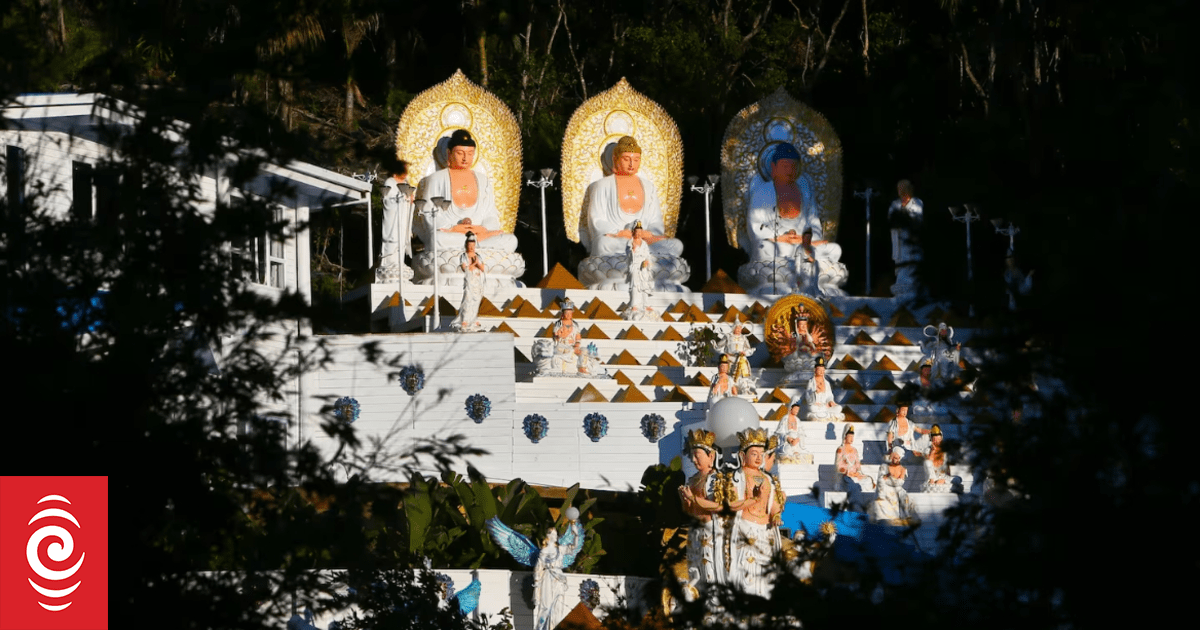
The tallest of the controversial statues at the Whangārei property are 4.5m and sit at the top of the terraces in Little Munro Bay.
Photo: Supplied/ Open Justice – NZME
In a bay of bush-clad slopes and quiet coastal homes, a hillside shrine of giant statues has become what locals consider an eyesore.
For years, the unauthorised installation has drawn crowds, complaints, and council scrutiny, but after a long-running battle, the seaside landscape will remain after a compromise was reached in the Environment Court.
Yanhua Wang, who owns several properties and businesses in Auckland, bought the Little Munro Bay property in Whangārei in 2010.
Native trees backing on to a reserve were felled, and a network of terraces and 146 statues, some as high as 4.5m, was installed.
After multiple complaints to the local council, a commissioner found in 2024 that the scale and placement of the terraces and statues created more than minor adverse landscape and visual effects.

The view over the statues from Little Munro Bay resident Greg Grant’s kitchen window.
Photo: Supplied/ Open Justice – NZME
The commissioner also noted that vegetation clearance and the colour choice of the structures added to the council and community’s concerns.
While the commissioner acknowledged Wang’s cultural beliefs, they concluded the proposal failed the gateway tests and consent was refused.
In that decision, the commissioner noted a different outcome could have potential if upper terraces were removed and some statues moved further down the embankment.
Yang appealed the decision to the Environment Court and the two parties went to mediation, where they reached an agreement.

The agreed plan for the site.
Photo: Environment Court/ Sanson and Associates, Simon Cocker landscape architecture
Under the agreement, the number of statues is to be reduced from 147 to 128, and the upper terraces will be removed within three months.
The upper slope is then to be vegetated with native plants and no artificial lighting or sound effects are to accompany the statues.
All terraces, roofs and statue supports must also be repainted in one uniform, low-reflect blue colour.
Most of the dwellings in Little Munro Bay are green to blend in with the surrounding bushland.
Planners and landscape architects for Wang and the council confirmed the revised proposal now passes the s104D tests and aligns with the District Plan’s outstanding natural landscape (ONL) and Outstanding Natural Coastal Area (ONCA) provisions.
In December, Environment Court Judge Jeff Smith accepted the agreement and issued a consent order under the Resource Management Act.
Smith emphasised the court was not making a merits determination but endorsing an agreement reached by the parties, noting the revised proposal “appears appropriate” and expert input had shaped the conditions.
The consent has a 12-month clause in which the council will review conditions if unforeseen landscape or visual effects arise.
Greg Grant lives across the road and has a direct view into the property from his kitchen.
Grant has been active in opposing the site’s resource consents for years and said it has all been a waste of time.
“The council people haven’t done their job, no matter what you say. It’s ridiculous,” he said.
Grant has a 40-year career as a builder on the coast and said he has been pulled up by the council over minor things.
“Then people come along and do what they’ve done across the valley there, it makes me angry beyond belief.
“I don’t know what we can do about it now.”
Grant said the new blue colour still sticks out among the native reserves, and even with the statues moved, they will still be in sight.
He said no one lives at the property and the site is empty most of the time, with only gardeners attending.
“It’s just become a shrine in the middle of nowhere. I still can’t get my head around what it’s there for.”
No one was on site when NZME went to visit.
The Whangārei District Council did not wish to provide comment to NZME.
*This story originally appeared in the New Zealand Herald.

Photo: Open Justice