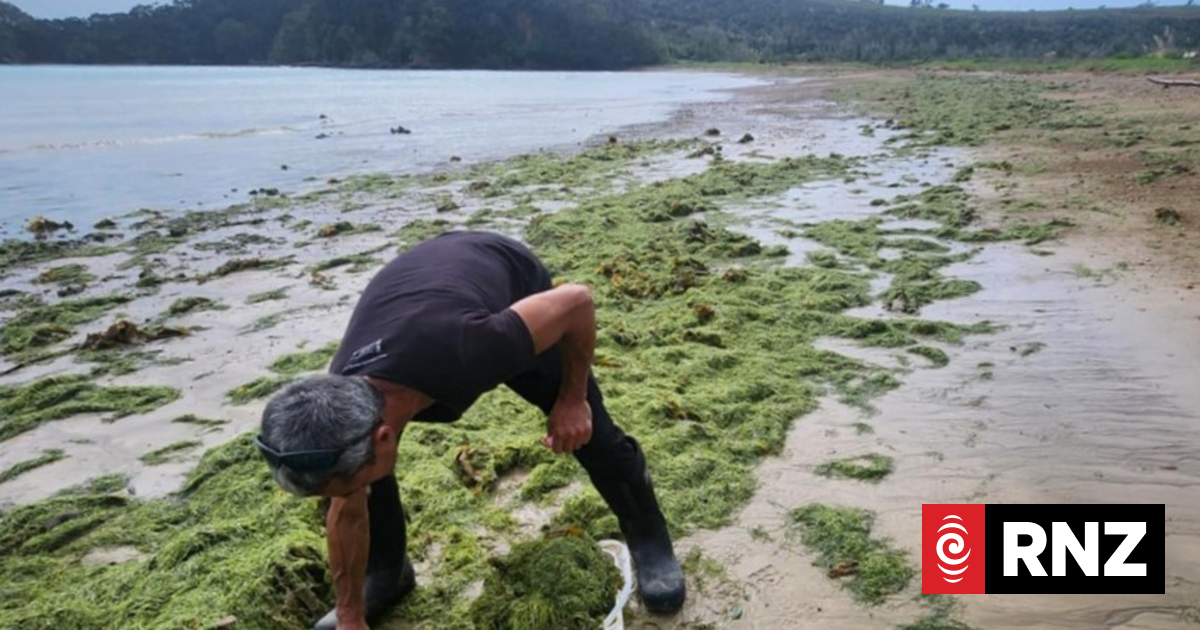

Cyclone Tam washed up hundreds of tonnes of caulerpa at Omakiwi Cove and neighbouring beaches.
Photo: Supplied / Ngāti Kuta, Patukeha
An invasive seaweed described as the world’s worst marine pest has mysteriously died off on a massive scale in Northland and the Hauraki Gulf.
Fast-growing caulerpa blanketed huge areas of seabed around the Bay of Islands and Aotea Great Barrier after it was first discovered in 2021, sparking grave concerns for marine ecosystems and the ability of future generations to gather kai moana.
However, since last summer, locals have seen the pest make a dramatic retreat.
At this time last year, Ōmakiwi Cove, where caulerpa was first found in Northland, was smothered in a dense, knee-high mat of weed.
Now Ngāti Kuta kaitiaki Rana Rewha said it was difficult to find any caulerpa on the bottom of the cove.
Biosecurity NZ pest management director John Walsh said the die-back – or biomass reduction, as scientists preferred to describe it – was first noticed off Aotea Great Barrier.
“We got Niwa on the job to confirm what was happening and try to identify some causes. They confirmed, yes, indeed, die-back was occurring, and it was significant. Some places where we had 90-100 percent coverage, it had virtually disappeared.”
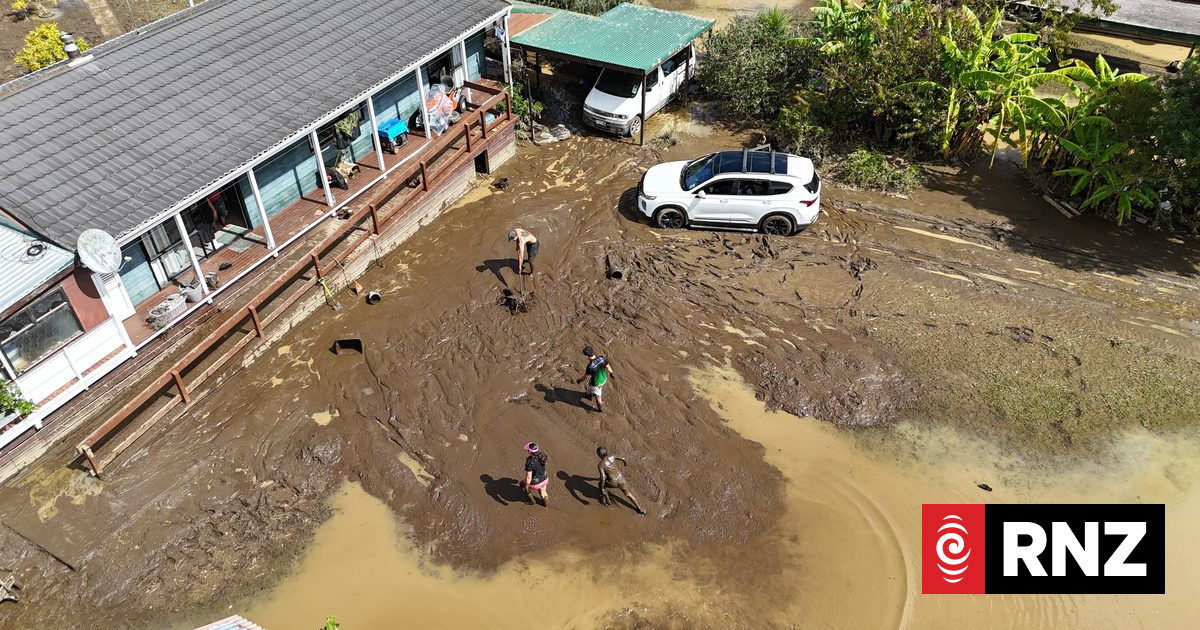
Later, the same thing happened in the Bay of Islands, starting after Cyclone Tam in April last year.
“It’s likely that the cyclone triggered the phenomena,” Walsh said.
“We know that there was a whole lot of disturbance and sedimentation. Sediment settled on top of the caulerpa, starved it of sunlight, and contributed to the dieback. But there’s probably other things that play as well.”

Johnson Brothers’ caulerpa dredge in action at Omakiwi Cove.
Photo: Supplied / Rana Rewha
In the meantime, Controlled Area Notices, which banned fishing and anchoring in certain areas, would remain in place, and divers would continue to check the Hauraki Gulf and the Bay of Islands.
Walsh warned against assuming the problem was over.
“It may well grow back. We don’t know. Over the course of the last few weeks, we’ve seen some indications of regrowth. It’s not very much. It may be early stages. We may see a return of those carpets so we’re keeping a pretty close eye on it.”
Walsh said the community group Conquer Caulerpa Trust was also continuing its survey work, and was successfully killing patches of caulerpa using mats and chlorine tablets.

Biosecurity NZ’s John Walsh takes instructions on operating the caulerpa dredge from inventor Andrew Johnson of Russell.
Photo: RNZ / Peter de Graaf
Another initiative to mechanically remove the pest from large areas of seabed was ongoing.
Working with MPI and the Northland Regional Council, Russell man Andrew Johnson had developed a barge-mounted suction dredge to hoover up the weed from the sea floor.
The next stage would be to attach his dredge-head to a remotely-operated underwater vehicle that could be controlled from the surface.
The vehicle, which resembled an underwater tractor, was currently being shipped from Scotland.
Walsh said the suction dredge was designed for tackling large carpets of caulerpa, which had largely vanished, but work would continue to develop the machine in case they returned.
He did not think the initial response to the caulerpa invasion had been an over-reaction.
“When we saw these multi-hectare carpets appearing, it was very, very concerning … I think people are right to be cautious about making assumptions that if the caulerpa has disappeared, it’s going to continue to be that way. We’ve got a window to breathe, that’s awesome, but it may well grow back. We don’t know.”
Rewha suspected changes in water temperature or storm sediment played a part in the weed’s decline.
“The storm we’ve had just now confirm whether or not it’s the sediment, because we’ve had literally thousands of tonnes of sediment pour into the Bay of Islands.”

Ngāti Kuta kaitiaki Rana Rewha first discovered caulerpa in the Bay of Islands.
Photo: RNZ / Peter de Graaf
Rewha also said it was too soon to assume the threat was over, because in the past week he had seen new growth on rocks at Ōmakiwi Cove, and a large new patch off Urupukapuka Island.
“So we are definitely being cautious. We’ve got our guard up because we’ve seen what it’s done in the past, how it’s just taken off just and carpeted everything over about 30 hectares within three months.”
Rewha said hapū concern over caulerpa stemmed from its threat to traditional food sources.
After Cyclone Tam dumped an estimated 500 tonnes of caulerpa at Ōmakiwi and nearby beaches, local hapū led a massive clean-up to stop the weed spreading around the Bay of Islands in the next storm.
Professor Barry Scott, a member of Aotea Great Barrier’s Tai Tū Moana steering group, said seasonal variation and caulerpa’s reproductive cycle were other possible factors in the weed’s decline, though unproven.
He described what had happened as recession, not die-back, because dying seaweed was not visible – it had simply vanished.
Kaumātua had told him of places around Aotea where caulerpa was “practically crawling up the wharf” two years ago, and now could not be found.
“No one really knows what’s occurring here. There’s clear evidence that some of these storms, like the one in Ōmakiwi, have changed the sea bed. I think the disappearance of it there is closely linked with the storm, and that may also be the case in some of the bays on Aotea.”
However, Scott said the weed had also receded at the Mokohinau Islands, where the water was “crystal clear” and sediment was not an issue.
“So there are a lot of unanswered questions. It’s really intriguing. I’m perhaps less alarmed about it now than I was, but sure as hell, this beast will be back.”
Scott said Aotea and the Bay of Islands had taken very different approaches to dealing with the invasive weed.
In the Bay, MPI had adopted a “big-tech” strategy, funding the development of a suction dredge designed to remove caulerpa from large areas of sea bed.
Scott, however, did not want to see such methods used at Aotea.
“Where the ecosystem is thriving, where it’s protected, it’s the most resistant to caulerpa. So our push is to do as much as we can to protect ocean ecosystems. Kina barrens, or places where there’s been dredging, they are prime sites for caulerpa to take hold.”
Sign up for Ngā Pitopito Kōrero, a daily newsletter curated by our editors and delivered straight to your inbox every weekday.