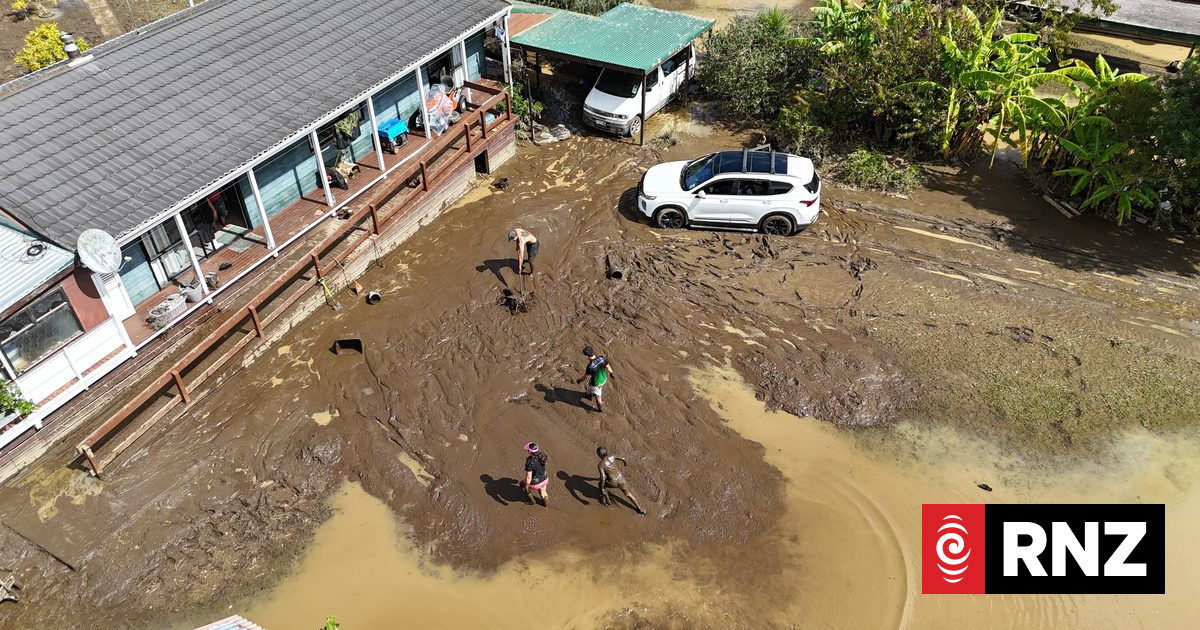

A family begins the enormous task of shovelling silt off their Whirinaki property.
Photo: Supplied / FNDC
Parts of the Far North are still cleaning up and some whānau are unable to return to their homes one week after a major storm battered the district.
The settlement of Whirinaki was worst hit in the deluge of 26 March, but many other areas around the Hokianga Harbour – including Wekaweka Valley, Waimamaku, Panguru and Pawarenga – were inundated and isolated.
Months’ worth of rain, more than 300mm, fell in 48 hours.
That was despite last week’s red heavy rain warning applying to the northeast coast, not western areas such as Hokianga.
Ruth Tautari, who is leading the recovery for the Whirinaki Trust, said the river burst its banks and flooded a roughly 2km stretch of State Highway 12 through the middle of the settlement.

Aerial view of Whirinaki and State Highway 12 after the storm.
Photo: Supplied / FNDC
The speed with which the water rose shocked even those who remembered the infamous 1999 floods.
“Within a 10 minute period, the water went from touching the road to running fully down the centre of the main highway, a metre high. It was pretty crazy.”
Tautari said 65 homes had been affected.
“Nine whānau homes were lost or damaged where the water went through. We have three whānau who are in emergency accommodation, we’ve got another three who are living with their whānau off site, and the other ones are living in the drier parts of their homes.”
Much of the clean-up was focussed on removing a deep layer of silt.
“In some parts it’s quite deep. About mid-thigh height, deeper in some places. We’ve got workers on diggers clearing access ways, clearing silt from whānau homes, and then we’ve got another couple of work crews in the river, removing some of the debris and slash that’s come down.”
Tautari said the silt had been contaminated by flooded septic tanks and was causing health problems, especially now it was drying out and turning to dust.
“There’s obviously respiratory issues and coughing, and a couple of people have gone down with sicknesses … The smell is gross.”
She said everyone had been evacuated safely before water swept through their homes.
Tautari said locals were grateful for the “huge support and awhi” they had received.
Whirinaki’s usual evacuation centre at Moria Marae was cut off by floodwaters, so Kōkōhuia Marae in Ōmāpere opened its doors to the evacuees until it was safe to go home.
Marae were also continuing to feed workers involved in the clean-up.
Green MP Hūhana Lyndon spent days visiting storm-battered settlements on either side of the Hokianga Harbour, including Whirinaki.
“All the debris, all the trees, all sorts came down. The river broke its banks in five places. It flooded right through the middle of the valley and cut off roads, services and flooded out homes. There’s massive silt damage across many homes and some are completely uninhabitable.”

Forestry slash is pushed up against a fenceline in Whirinaki.
Photo: Supplied / FNDC
If that was not bad enough, Whirinaki had also been hit by fire.
One of the flooded homes burnt down on Sunday night in a blaze thought to have been caused by water getting into the wiring.
“So the haukāinga have now commissioned an electrician to do a full assessment of the water-logged homes, because you need to start repairing or finding alternatives for these whānau. And you can’t do that if the blinkin’ house burns down.”
The soaring price of fuel was putting more pressure on flood-affected residents.
“We’re trying to keep whānau at home so services get out to them, and they don’t have to go looking for kai and access to supermarkets and driving to Kaitāia when the roads are so bad.”
Lyndon said some residents were getting the “0800-number merry-go-round” as they tried to contact the many different government agencies they needed to deal with.
After the January flood in Ōakura, the Whangārei District Council ran a series of highly successful “drop-in clinics” where people could talk to all agencies and service providers in one place.
She urged the Far North District Council to do something similar.
Areas that recorded the highest rainfall included the isolated Wekaweka Valley, just north of Waipoua Forest.
Max Osborne said he had seen many storms since he moved to the valley since 1974, but none as damaging as last week’s deluge.
He said the force of the water piled up rocks three metres deep against a bridge, diverting the river and flooding homes further downstream.

The Wekaweka Road bridge is buried somewhere under those rocks. A guard rail can be seen on the left.
Photo: Supplied / Jessie McVeagh
After being cut off for days, Osborne and a neighbour walked around the buried bridge and a major slip, then hitchhiked to the nearest town for supplies.
Power and communications were out for days and the road reopened on Tuesday night, five days after the storm.
Osborne said he was fortunate because his home was undamaged.
Kaikohe-Hokianga Community Board member Jessie McVeagh said she had been door-to-door with Civil Defence crews to check on residents in places like Wekaweka Valley.

Max Osborne (left) had to walk and hitchhike to the nearest town for supplies after being trapped in his home for days. The Wekaweka Road bridge is buried somewhere under those rocks.
Photo: Supplied / Jessie McVeagh
Further downstream, in Waimamaku, the whole valley had filled up a like a lake.
Some people still lacked basic necessities, she said.
“There’s places now that still don’t have water and we’re calling in for drinking water and tankers now. And containers to collect it, because some people have lost everything.”
Ruth Tautari said the past week had been tough, but the storm had brought out the best in her community.
“Everyone’s been helping each other, and we’ve been really resilient, but you can see the toll and the trauma and the heartbreak in our whānau and it’s heartbreaking to see. The positive side of it, it’s really good to see the strength of the community working together.”
The Far North District Council said it was now clear the west of the district had suffered the worst effects of the storm.
Rapid Response Teams and the Defence Force had so far distributed food and water to nine towns and settlements, from Kaitāia in the north to Waimamaku in the south.
As of Wednesday, 377 homes had been assessed, and portable toilets, skips and septic tank assessments had been provided.
All 99 roads affected by flooding or slips had reopened, but 11 still had restrictions in place such as being reduced to one lane.
The council was due to decide on Thursday whether to extend the state of emergency in place across the district since the 26th of March.
Sign up for Ngā Pitopito Kōrero, a daily newsletter curated by our editors and delivered straight to your inbox every weekday.