
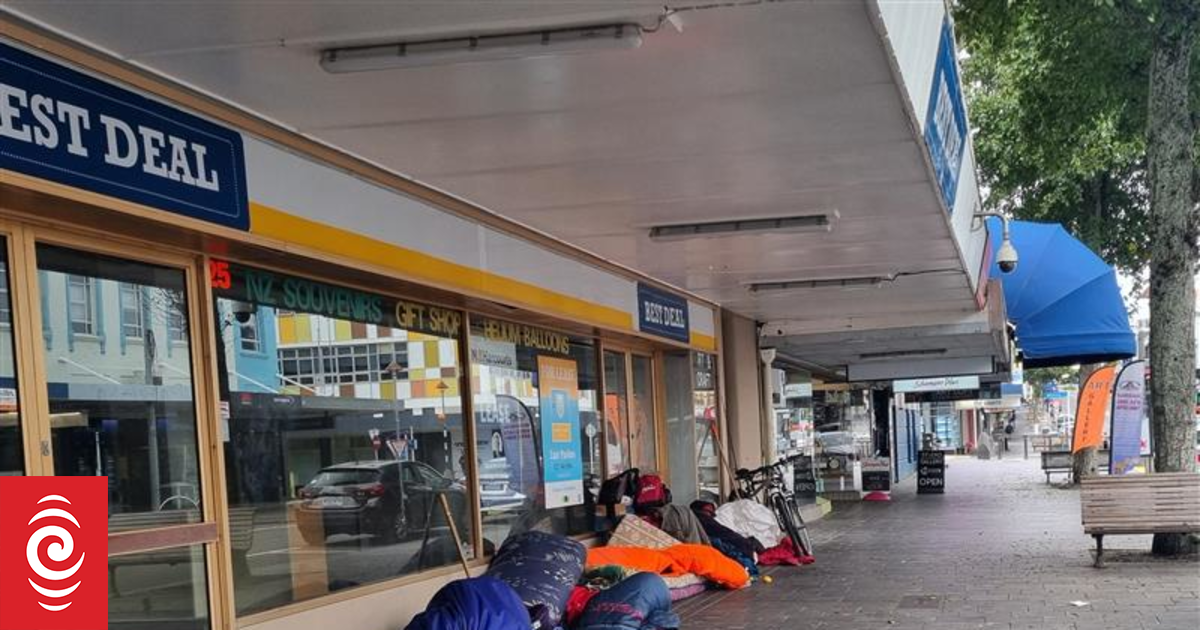

Rough sleepers in New Plymouth, in Northland rough sleepers are typically waiting for more than 800 days for a home through Housing First.
Photo: RNZ / Robin Martin
In Northland, rough sleepers typically wait more than 800 days for a home through the Housing First. The nationwide programme helps chronically homeless people into housing. It’s effective, and successive governments of both stripes support it. But a Northland provider says “horrendous” wait times are driven by a lack of funding, and a lack of homes. Lauren Crimp reports.
Casey Tangira, her husband, four kids and niece spent four months living in a car in 2024.
They had been in the same rental in the Northland town of Opua for eight years – but their landlord needed the house back, and they had nowhere else to go.
They parked up at a local rugby clubrooms, and showered at a freedom camping facility nearby.
But winter hit, and it got too cold, so they sought shelter with their in-laws.
Ten people crammed into a two-bedroom converted shed in Northland, sleeping on couches and mattresses on the floor.
“It was hectic, very stressful, just on edge all the time,” Tangira said.
Finally, after just over a year registered with Housing First through Ngāti Hine Health Trust, they were placed into a home near Moerewa, in the trust’s housing development.
“Were just so over the moon, that we could have a house of our own … and we could just be settled.”
The kids were not themselves when they were homeless, Tangira said. In their new home, they have their sparkle back.
“Just seeing my children waking up every morning and smiling and having their own beds… it’s my kids that I worry about the most,” she said.
“We’re just so grateful to Ngāti Hine every day.”
Northland, Bay of Plenty rough sleepers face longest wait
Tangira’s story is not unusual in Northland. In fact, a year-long wait is shorter than what’s typical: 826 days, from being accepted into Housing First, to being housed.
Bay of Plenty has the next longest median wait time of 566 days.
In other regions it’s between 100 and 300 days, aside from Waikato, where it’s 70 days.
The housing ministry allocates Housing First “places” – that is, funding for a person to be housed – to providers like Ngāti Hine Health Trust, who find homes for rough sleepers, often leasing them through the private market.
The ministry said at the end of January there were 3613 households in the programme, of which 2596 had been housed.
That leaves more than 1000 people who have sought help – and been told they could get it – still waiting.
Ngāti Hine Health Trust chief executive Tamati Shepherd-Wipiiti said its allocation of 60 places is full, and up to 100 people are on the wait-list.
Single men, often just released from prison, usually wait the longest, he said.
That’s because “in these constrained times” the Trust is forced to make tough choices, and prioritise.
“You have to draw a line about what you find unacceptable. And for us, that’s families in cars,” Shepherd-Wipiiti said.
“We won’t have families in cars.”
He said the problem was twofold: housing supply, and funding.
In Moerewa and Kawakawa, there aren’t enough homes to lease from the private market, so Ngāti Hine is building some.
In Whangārei, the Trust could house 10 whānau immediately – if it had sufficient Housing First places, Shepherd-Wipiiti said.
He’s asked the housing ministry to consider upping its allocation.
The government funded an extra 300 Housing First places last year for Auckland, Hamilton, Wellington and Christchurch.
Tamati Shepherd-Wipiiti wants the government to think smarter about the distribution.
“It was a bit sad to hear that some providers aren’t actually reaching their cap because, if we run this sort of as a national network, we could easily fill that gap for people who are actually struggling to fill their cap,” he said.
However, the shortage isn’t just felt in Northland – Auckland City Missioner Helen Robinson has said her city alone needed 1000 more places.

A South Auckland house which has been allocated under the Housing First programme which places chronically homeless people into permanent housing.
Photo: RNZ / Eva Corlett
National, Labour won’t commit to more funding
Associate Housing Minister Tama Potaka said since September nearly 500 rough sleepers had been housed through Housing First, and the government was spending “hundreds of millions, billions of dollars into supporting people who have been doing it tough in this space”.
He said households and providers must navigate “challenging social circumstances and local housing market conditions” to secure appropriate housing.
RNZ asked whether an 800-day wait time was acceptable.
“I don’t think anyone is happy to see people doing it tough on the street or living in a rough space,” Potaka said.
“No one wants to see Kiwis living under a bush, in a car, in a cowshed.
“And that’s why we’ve been really clear, we want the funds that we have applied to this space to be used efficiently and effectively.”
Labour’s housing spokesperson Kieran McAnulty said the need for Housing First jumped after the [https://www.rnz.co.nz/news/political/525607/government-was-warned-emergency-housing-crackdown-could-increase-homelessness
government made it tougher to access emergency housing] nearly two years ago.
“When you consider that they’ve saved a billion dollars by keeping people on the street … the amount that they’ve put into Housing First is an absolute fraction of that,” he said.
“It is a drop of water into an empty bucket.”
But he would not commit a potential Labour government to boosting Housing First support.
McAnulty said that call would be made after it considered this year’s budget, so it knows what money it had to work with.
While politicians battle over budgets, Casey Tangira thinks about other vulnerable people in her community, who she noticed when she was living in her car.
“Down the park and behind the library and that there was a lot of other homeless people too,” she said.
“I just want to bring them all home.”
Sign up for Ngā Pitopito Kōrero, a daily newsletter curated by our editors and delivered straight to your inbox every weekday.