
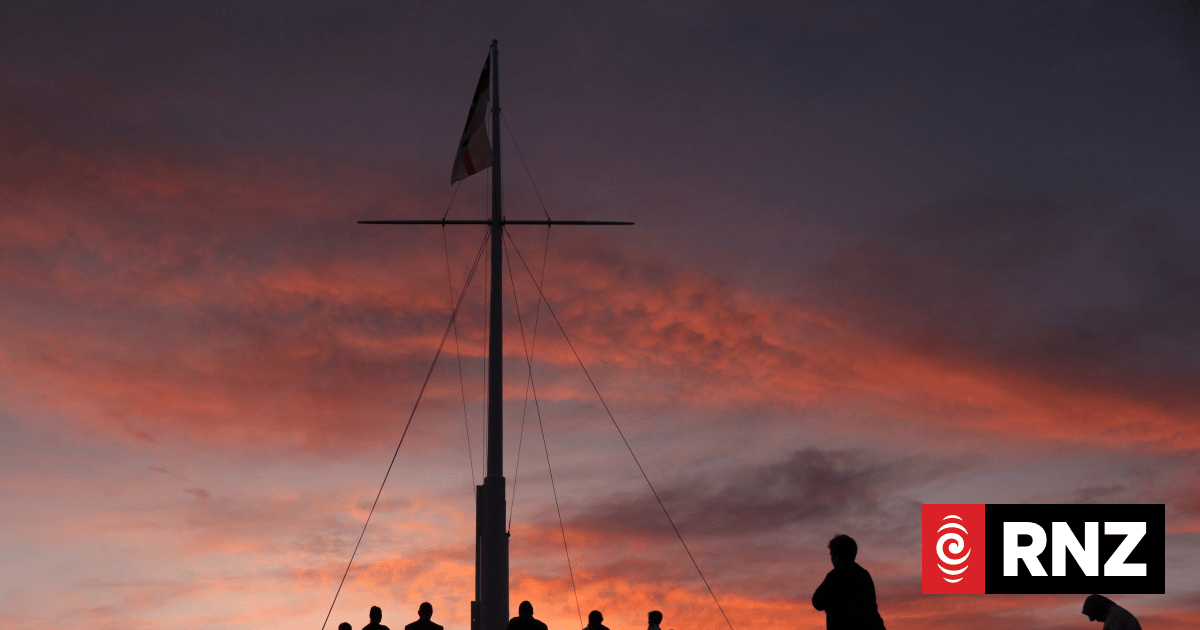

People gather at dawn atop Maiki Hill, or Flagstaff Hill, for the 175th anniversary of the Battle of Kororāreka in 2020.
Photo: Peter de Graaf
A ceremony on a Bay of Islands hilltop at dawn on Wednesday aims to preserve the memory of a war that changed New Zealand history – and make sure the stories are passed on to a new generation.
Early on 11 March, 1845, fighters loyal to Ngāpuhi chief Hone Heke chopped down the flagpole at Russell, then still better known as Kororāreka, for the fourth time.
The felling of the flagstaff was a signal for men led by Hone Heke and Ngāti Hine chief Te Ruki Kawiti to attack the Bay of Islands town.
In the ensuing battle most of the town’s European inhabitants were evacuated to Auckland, and about 20 Māori and 13 Britons were killed.
It was the start of the wider Northern War which raged until early 1846, culminating in the famous, but inconclusive, battle of Ruapekapeka Pā.
Kororāreka Marae chairwoman Deb Rewiri said remembering events such as the Battle of Kororāreka was as important as observing Anzac Day.
“Because if you think about it, the foundation of Aotearoa New Zealand was being played out here in the North at that time,” Rewiri said.
She expected a large crowd for Wednesday’s 181st anniversary because of the nationwide interest sparked by the Battle of Ruapekapeka Pā commemorations in January.
The ceremony would begin at 6.45am with a service at Maiki Hill, or Flagstaff Hill, then continue at Christ Church, New Zealand’s oldest surviving church.

Navy sailor Brandyn Sigley lays a wreath at the HMS Hazard memorial during the 175th anniversary commemorations of the Battle of Kororāreka in 2020.
Photo: Peter de Graaf
There, members of the Royal New Zealand Navy would lay a wreath at the grave of sailors from the HMS Hazard who died in the battle.
Karakia would also be held at a nearby kōhatu (stone) marking the spot where the first blood was spilled.
Commemorations would wrap up at Haratu Marae, on the town’s waterfront, where children from Te Kura o Kororāreka (Russell School) would raise a new kara (flag) and be presented with a paraikete (blanket) embroidered with their impressions of the battle.
Rewiri said she was inspired to get local children involved after attending Treaty commemorations in Mangungu, in South Hokianga, last month.
The outbreak of war in the Middle East made tomorrow’s ceremony all the more relevant.
“We’re a little bit removed from that, but also I think it’s not so much about a war going on, but there’s certainly levels of deprivation within our own country, so holding fast to the past reminds us of how resilient and purposeful our tūpuna were. Their aim was to help us to grow so that we are all thriving, and this is what we hope to do.”

Kororāreka Marae chairwoman Deb Rewiri.
Photo: RNZ / Peter de Graaf
She said the reasons Hone Heke and Kawiti went in to battle included what they saw as erosion of their tino rangatiratanga and the government’s failure to adhere to Te Tiriti, signed just five years earlier.
At the Ruapekapeka commemorations in January, Ngāti Hine leader Pita Tipene said economic factors also played a part, with the government’s decision to shift the capital from Ōkiato (near Russell) to Auckland leading to a sharp drop in trade.
Rewiri said during the battle, fighters gave fleeing civilians safe passage out to ships waiting to evacuate them to Auckland.
“They didn’t want to harm those people. Their disagreement was not with them but with the Crown, and that continues today. We’re in 2026 and we still have that battle, back at the Crown.”
Rewiri said there was little parking at Maiki Hill so those keen to take part in the dawn ceremony were encouraged to take one of the shuttles leaving from Haratu Marae and Kororāreka Museum starting at 6.15am.
For those coming across the water, the first car ferry from Ōpua was due to leave at 6am.
The current flagpole atop Te Maiki Hill was erected in 1858 by Maihi Parāone Kawiti, a son of Te Ruki Kawiti, as a symbol of national unity and reconciliation.
It survived a wild fire in 1913 and serious vandalism in 2022.
The new flag to be raised at Haratu Marae, called Kororāreka Whakaora, was designed by Lyall Hakaraia (Ngāti Kuta, Patukeha) of the British Museum.
Rewiri said about 200 people were expected to take part in the commemorations.
Sign up for Ngā Pitopito Kōrero, a daily newsletter curated by our editors and delivered straight to your inbox every weekday.