
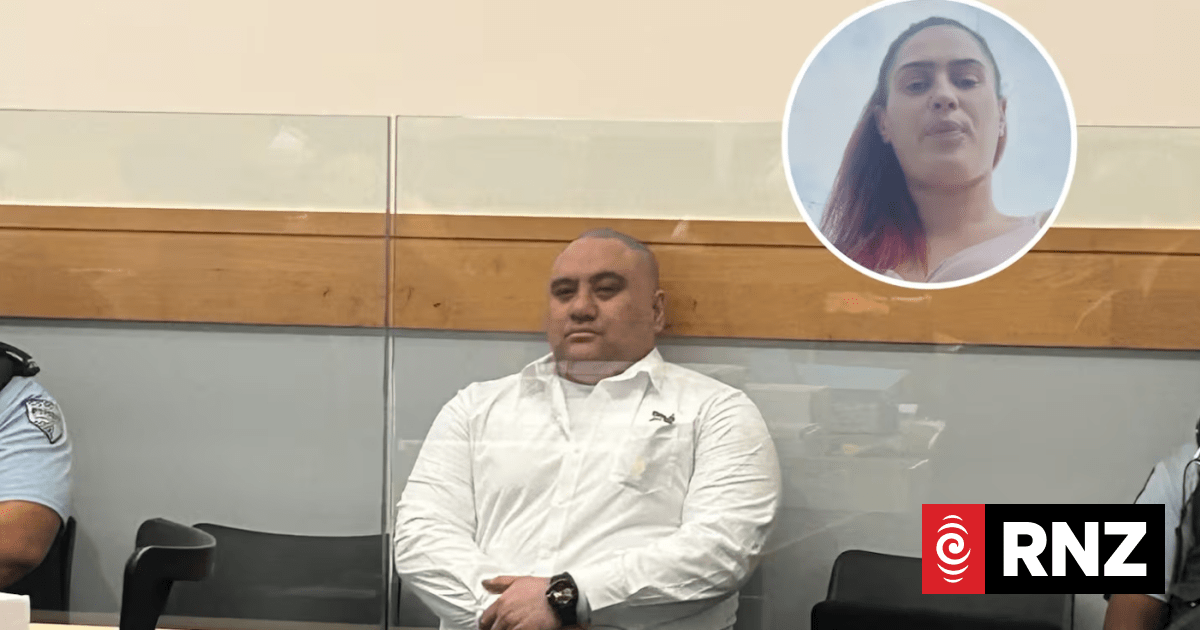

Anaru Morunga is on trial for the alleged murder of his ex-partner and the mother of his two children, Jasmaine Reihana.
Photo: NZME/SUPPLED
Warning: This article discusses graphic violence and may be upsetting to some readers.
After two weeks of silence, the defence in a murder trial finally rose and shifted the focus from the brutality of an alleged act to the question of the accused’s state of mind.
As Anaru Morunga’s trial nears its end, today marked the first moment defence lawyer Arthur Fairley addressed the jury and reframed the case.
“We’re dealing with this man’s mind. Not your mind, not my mind … it’s what this man’s mind thinks,” Fairley said in his closing statement.
Morunga has been on trial in the High Court at Whangārei on eight charges, including murder, related to events surrounding the death of his ex-partner, 35-year-old Jasmaine Reihana.
The couple had two children together but separated in 2018. It was unclear what the status of their relationship was at the time of her death on 8 September, 2024, after they had attended a tangi together in Ōtorohanga.
For 10 days, the jury has heard evidence from multiple Crown witnesses, including forensic experts and police officers, about events that occurred across the days leading up to Reihana’s death.
The Crown alleges Morunga murdered Reihana by stabbing her at the Pouto peninsula home in Northland that he shared with his mother, Suzanne Morunga, and her partner Michael Jones.
He is also accused of arson after allegedly setting Reihana’s car alight with her body inside at the far end of the Ripirō Beach farm, before fleeing and leading police on a State Highway 12 chase that ended with his arrest near the Brynderwyn Hills.
Today, he changed his plea on two of the eight charges he has been defending, admitting charges related to unlawfully taking a tractor and quad bike owned by his boss, Chris Biddles.
On the other charges, Morunga has repeatedly acknowledged killing Reihana, telling police he cut her throat before placing her body in her car and towing it to the beach by tractor. He continues to deny that he was the one who set the vehicle alight.
That admission has not only been heard by the jury through his evidential interview with police played in court, but also when he chose to take the stand yesterday.
“I just walked over to her, grabbed her, pulled the knife out and cut her throat,” he said in his police interview recorded in September 2024.
But when he gave close to four hours of evidence yesterday, his narrative changed.
He claimed Reihana had a gun and he had to kill her to protect his family.
“I pulled, she pulled, I won,” he testified.
He then demonstrated for the court how he cut Reihana’s neck.
In Crown closings, prosecutor Bernadette O’Connor told the jury Morunga was making things up to fit the evidence that had been presented.
“Folding up the paper napkin so it resembled a knife. Not something he was asked to do, something he did of his own volition to demonstrate how he killed Ms Reihana,” O’Connor said.
“Claiming he didn’t mean for her to die. I submit that flies in the face of the evidence and flies in the face of common sense.
“He meant to kill her.”
O’Connor said there were eight pages of transcript of Morunga detailing the slaying, even saying he was good with knives and trained to kill animals humanely.
“He didn’t seem to afford that humane killing to Jasmaine Reihana,” O’Connor said.
She said the new story about a gun being present was “simply not true”.
“When I pointed out he has never mentioned it, he said ‘I was a very broken man then’,” O’Connor said.
“A broken man? Or a man who was relaxed, enjoying his moment in the spotlight?”
O’Connor said Morunga had made a “fantastical story” that Reihana was having an affair, she was going to kill his family and sell his children to the Mongrel Mob.
“He will come up with anything that he can to get away with murder.”
O’Connor said he was high on methamphetamine, and being under the influence of drugs was not a defence to murder.
“The fault for her murder lies solely and squarely at the feet of Anaru Morunga.”
During the trial, Morunga’s lawyer, Arthur Fairley, did not cross-examine many witnesses and did not give an opening statement to the jury.
Today, in his closing address to the jury, he began by acknowledging the overwhelming evidence presented at the trial.
“I would suggest to you, members of the jury, there wouldn’t be a heart in this room that wouldn’t be tugged by that,” Fairley said.
“But in this room, in a trial like this, we’re not allowed to have our hearts tugged.”
Fairley said the key issue for determining the murder charge relied on establishing Morunga’s intent.
“The facts are, none of us were there,” Fairley submitted.
“He made some remarkable concessions for a man in a murder trial.
“Here’s the point. You might think the mind we’re dealing with at the material time had an imaginative grip of reality. But that’s the quality of the mind that has to be taken into account.”
Fairley submitted that Morunga had not uttered that he was going to kill Reihana before, during or after the act and therefore did not have murderous intent.
“Isolate what the issues are and try to give some analysis,” Morunga said.
“On the murder, they can’t make you sure what was in this man’s head at the material time.
“If they can’t make you sure, he’s not guilty of murder; it’s manslaughter.”
The jury was released for the weekend and will return on Monday for Justice David Johnstone’s summation of the case.
They will then retire to consider the verdicts.
* This story originally appeared in the New Zealand Herald.